Oracy
We support children to become confident communicators who can express ideas clearly, listen attentively and engage respectfully in conversations within school and the wider community.

Intent
At Bloxwich Academy Primary, the intention of the Spoken Language (oracy) curriculum is to enable pupils to become well-spoken and articulate individuals. Spoken language skills are vital and need to be fostered and developed from an early age to enable pupils to grow into well-spoken and successful adults. It is the ambition of the oracy lead to promote a love for oracy, and for both staff and pupils at Bloxwich Academy Primary to be able to communicate effectively.
To promote active engagement in lessons, oracy strategies are encouraged to be used across the curriculum and pupils are encouraged to collaborate with different individuals, both peers and adults. Mental health and well-being continues to be an important agenda at Bloxwich Academy Primary; it is believed that good spoken language skills will enable pupils to communicate their needs and share their emotions more openly.
Oracy Framework
At Bloxwich Academy Primary, we work alongside Voice 21 to provide our pupils with high quality, evidence-informed oracy teaching. At the heart of the teaching lies the Voice 21 Oracy Framework, which sets out the skills that will support develop pupils’ spoken language skills and confidence.
These skills are important for pupils to develop as they grow up in the modern world and intend to be developed further through secondary school and into the wider world.
Talk and effective communication is fundamental to learning and underpins success across the curriculum as pupils verbalise their thoughts and ideas before applying into written tasks. Through structured talk, discussion and presentation, pupils learn how to express ideas clearly, listen actively and engage respectfully with others.
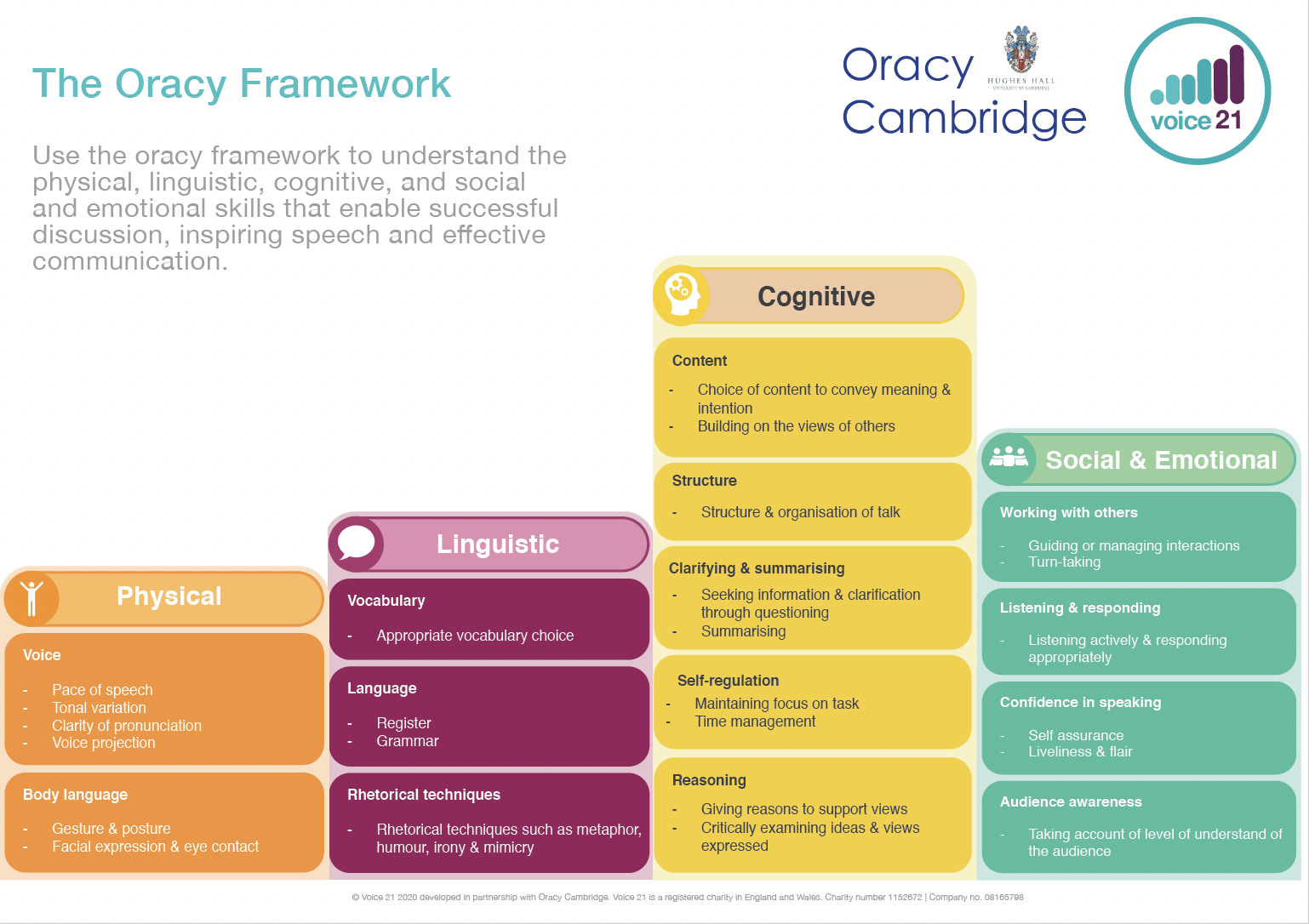
The Voice 21 Oracy Framework is built around four key strands, which are introduced in our classrooms:
Physical
The physical strand is all about using your body effectively when presenting to any audience.
· Using clear pronunciation, appropriate pace and volume
· Developing confident body language, eye contact and posture
· Adapting voice and gesture to suit different audiences and purposes.
Linguistic
The linguistic strand details the vocabulary and sentence types used when speaking, including dialect and accent.
· Using ambitious vocabulary and subject-specific language
· Structuring sentences and ideas clearly
· Using appropriate grammar and language choices for different contexts.
Cognitive
The cognitive strand considers the structure of talk and the way it is organised.
· Organising and developing ideas logically
· Giving reasons, explanations and justifications
· Asking relevant questions and building on the ideas of others.
Social and Emotional
The social and emotional strand is all about how people communicate and work with others.
· Listening attentively and responding thoughtfully
· Taking turns and respecting different viewpoints
· Building the confidence to speak in front of others and work collaboratively.
Discussion Guidelines
Pupils work in collaboration with each other and the adults they work with to establish discussion guidelines, which underpin the expectations for talk in each year group.
The guidelines centre around the oracy framework strands and are age-appropriate to allow all pupils to be successful. They are essential to ensuring that all pupils are respectful and allow everyone’s voice to be valued and listened to.
Smart Schools Council
Smart Schools Council is run by our Junior Leadership Team (JLT) in classes. These meetings are vital for how our school runs as it ensures that all of our pupils’ voices are valued and listened to.
Pupils have previously influenced decisions about extra-curricular clubs and charity fundraising events and continue to contribute ideas that help shape the school environment.